Micro-entreprise
Can a Micro-Entrepreneur in France Invoice a UK Client in Pounds and in English?
Yes to both. French law fixes nineteen mentions on an invoice and neither the language nor the currency is one of them. What has to stay, and what you declare when the sterling lands.
28 Oct 2026 · 4 min read · By Sophie Kazandjian
Yes to both. French law fixes nineteen mentions that have to appear on an invoice, and neither the language nor the currency is one of them. You can bill a client in Manchester in sterling, write the whole invoice in English, and stay compliant, provided the French mandatory lines are on it.
Why currency is free
The tax code says the amounts on an invoice may be expressed in any currency, provided the amount of tax to be paid is determined in euros. On an invoice to a UK business there is no French VAT to determine, whether you are under the franchise or registered, so there is nothing to convert. No text requires a euro equivalent, an exchange rate or the amount in words. Guidance that says otherwise has no basis in the law.
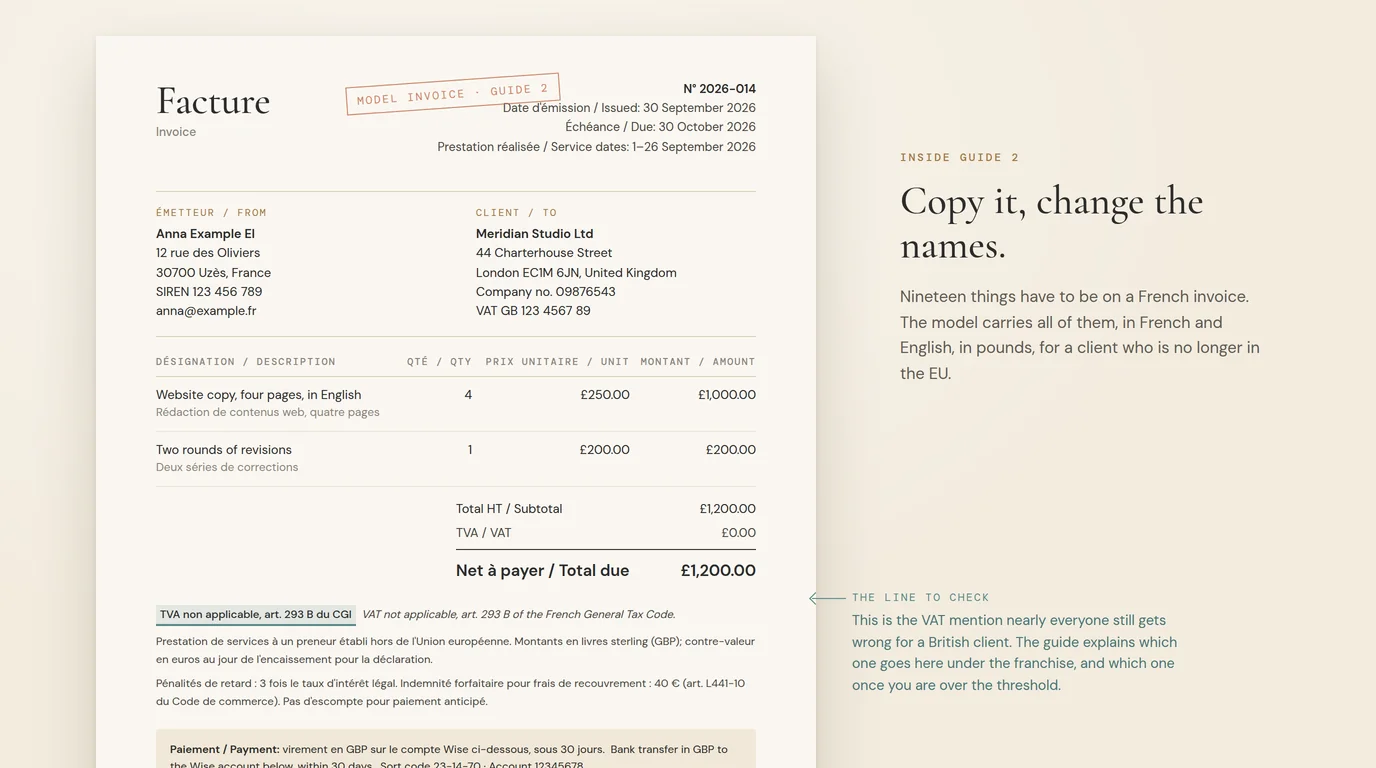
Showing an indicative euro value and the rate you used is still worth the one line, because that figure is the one you will declare to URSSAF when the money lands, and it saves working it out twice. The model invoice in the guide carries it as a single line under the total: payable in GBP, indicative value in euros at the ECB rate of the invoice date.
Why language is free, and why bilingual is the tidy answer
An invoice in English is allowed. In an audit the tax administration may ask for a translation of a foreign-language document by a sworn translator, and it does so case by case rather than as a routine. The simplest way to remove the question is a bilingual invoice: the French legal mentions verbatim, with the English alongside. That costs nothing once the template exists, and it means an inspector reading your file and a client's bookkeeper in Leeds are reading the same document.
Your accounting records themselves, the receipts register in particular, must be kept in euros. The invoice can be in pounds; the register entry for it cannot.
What still has to be there
Invoicing in English does not change the list. Your name with EI immediately next to it, your SIREN, your address, a continuous invoice number, the date, the client's name and address, the description and amounts, the due date, the late-payment penalty rate, the €40 recovery fee and the escompte line all stay, in French or in both languages. The VAT line is the one that most often goes wrong on a UK invoice: Autoliquidation is the intra-EU mention and has been wrong for a British client since January 2021. Under the franchise you keep "TVA non applicable, art. 293 B du CGI" and add "TVA non applicable, art. 259-1 du CGI"; registered for VAT, you use the 259-1 line alone.
A courtesy line in English under the French ones, saying the service is supplied to a business outside the EU and the customer accounts for any UK VAT under the reverse charge, is optional. HMRC does not require any wording from you for the client's reverse charge to work, but the client's accounts department will usually be glad of it.
What a UK invoice must not be
It must not be a second, informal document outside your numbering. Some freelancers keep a "UK invoice" in pounds alongside an official one in euros, or number their British work separately. Invoice numbers have to run in one unbroken chronological sequence, and distinct series are permitted only where your circumstances justify them. One invoice, one number, one register. If a client's accounts department wants a different layout, give them the same invoice with their purchase order number on it, not a different invoice.
And when the pounds arrive
You declare the euro value on the day the money was at your disposal, which for a bank transfer is the day it is credited, whether or not you convert it. Which exchange rate to use is its own question, and the short version is that URSSAF publishes no rule, so you borrow the income-tax one and apply it every time.
Questions
- Do I have to show a euro amount on an invoice in pounds?
No. Nothing in the tax code requires it when there is no VAT to compute. It is good practice, because it is the figure you will declare, and the model invoice in the guide shows it as one line under the total.
- Will the French tax office accept an invoice written only in English?
Yes. It may ask for a sworn translation during an audit, case by case. A bilingual template, French mentions with English alongside, removes the question before it is asked.
- Can I keep a separate numbering series for UK clients?
Only where your circumstances justify a distinct series, and they rarely do. One sequence for everything is the safe choice; a gap or a parallel series is what an inspector notices first.
The full guide · €19
Invoicing a UK client from France
Thirteen pages, with a bilingual model invoice in sterling to copy. Every figure sourced and dated.
Get the guide →Or all three guides with the URSSAF tracker and the deadlines calendar: Micro Admin 2026/27, €49.
Other questions
- Do I Have to Put EI After My Name as a Micro-Entrepreneur?
- The €40 Recovery Fee and the Late-Payment Line Every French Invoice Needs
- Do I Have to Declare My Wise Account in France? Form 3916 for Micro-Entrepreneurs
- Paid in Pounds: Which Exchange Rate Goes on the URSSAF Declaration?
- Does UK Client Income Count Towards the French VAT Franchise Threshold?
- Invoicing a UK Client from France: Which VAT Line, and Why Autoliquidation Is Now Wrong
Everything answered so far, in one place. If your question is not there, email it to [email protected]; the ones that come up more than once get a page.