Tools & Tutorials
Invoicing a UK Client from France: Which VAT Line, and Why Autoliquidation Is Now Wrong
Autoliquidation is the wrong line for a UK client since Brexit. What a micro-entrepreneur in France must put on the invoice instead, and what to declare when the money lands.
14 Aug 2026 · 7 min read · By Sophie Kazandjian

Most of the invoices I see from English-speaking micro-entrepreneurs in France carry a VAT line that was correct in 2019. It says Autoliquidation, sometimes with a reference to article 283 of the CGI underneath, and it is sitting on an invoice to a client in Manchester. It has been wrong since the first of January 2021, nobody has told the person sending it, and the client has never queried it because the client has no idea either.
Nothing terrible happens immediately, which is the problem. The wrong wording does not bounce. It sits in your records and in theirs until somebody looks, and the person who eventually looks is either an inspector or the accountant you hire in three years' time.
I have been a micro-entrepreneur in the Gard since 2018 and most of my clients are British. What follows is what actually goes on the invoice, why, and what to do afterwards, with the two places where the official answer does not exist yet marked as such.
Why Autoliquidation stopped being right
Autoliquidation is the French word for the reverse charge, and the reverse charge is an intra-EU mechanism. When you invoice a business in another member state, you charge no French VAT, the client accounts for it in their own country under the EU rules, and the word on the invoice tells everyone that is what has happened. It works because both of you are inside the same system, and it is backed up by a return to customs, the DES, that lets the two tax administrations match the transaction.
The United Kingdom left that system. There is no intra-community mechanism between France and Britain any more, so there is nothing to reverse-charge, no intra-community VAT number to quote for your client and no DES to file for them. If you have been filing a DES that includes UK clients, you have been declaring something that does not belong there.
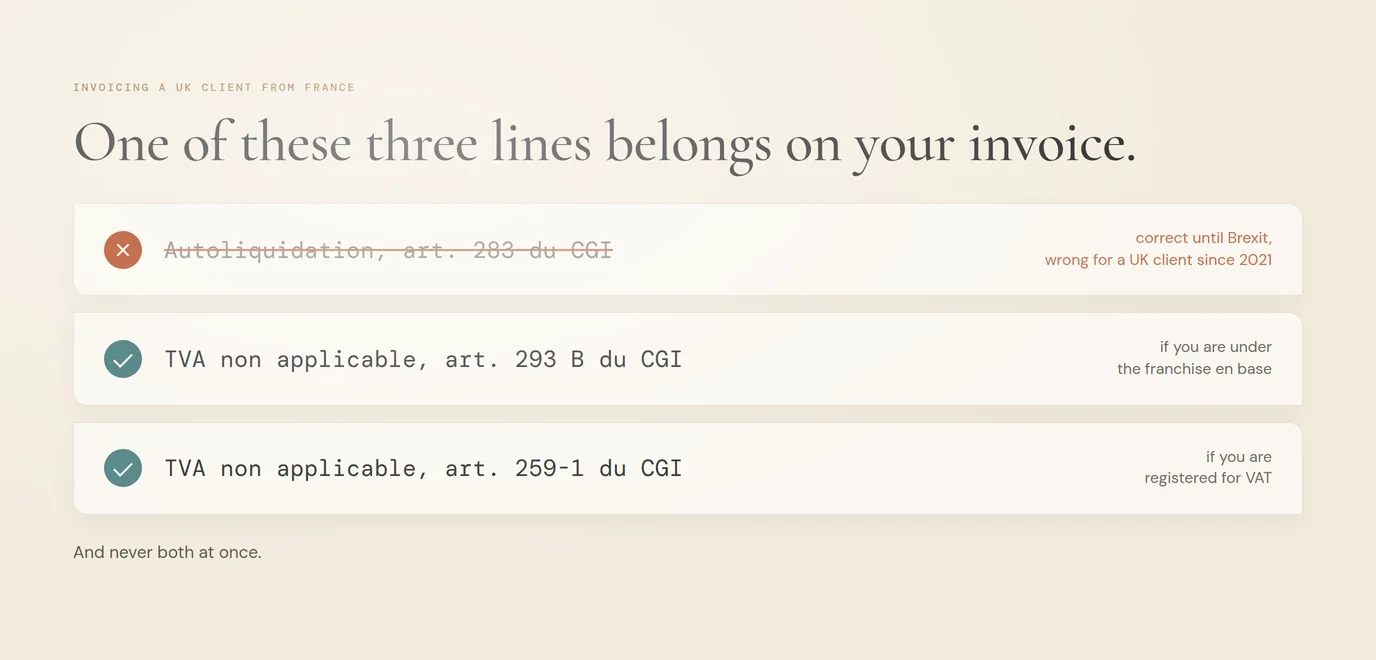
What replaced it is quieter. A service supplied to a business outside the EU is simply not taxable in France, because the place of supply is where the client is established. That is article 259-1 of the CGI, and it is the article your invoice should point at.
The line that goes on the invoice instead
Which wording you use depends on one thing: whether you are under the franchise en base or registered for VAT.
If you are under the franchise, the line you already have is the one that matters. TVA non applicable, article 293 B du CGI. That is the statement that you do not charge VAT at all, on anything, to anyone, and it covers a British client as it covers a French one. You do not need to add anything about the reverse charge, and you should not, because you are not reverse-charging anything.
If you are registered for VAT, that line does not apply to you and you need the place-of-supply wording instead. Something like TVA non applicable, article 259-1 du CGI, prestation de services non imposable en France does the job, and adding an English gloss underneath, "VAT not applicable, services supplied outside France", costs you nothing and saves your client's bookkeeper an email.
The mistake to avoid is carrying both lines. I have seen invoices with 293 B and Autoliquidation stacked on top of each other, which says two contradictory things at once and suggests, correctly, that the sender copied a template.
The other eighteen things
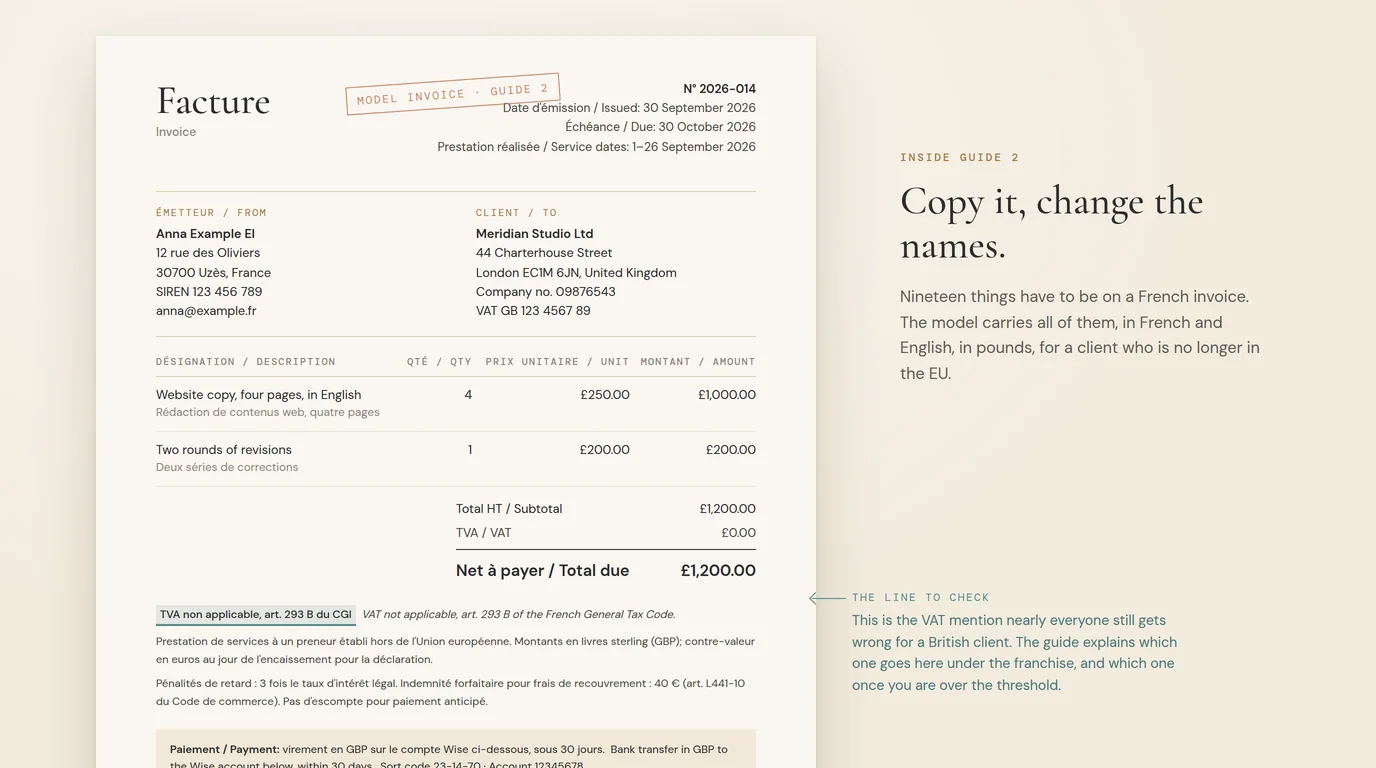
The VAT line is one of nineteen mentions that French law requires on an invoice, and the ones people miss are rarely the exotic ones. Three come up again and again.
EI after your name. Since May 2022, an entrepreneur individuel must show "EI" or "Entrepreneur Individuel" immediately before or after their name on invoices and commercial documents. It arrived with the reform that separated your personal and business assets, most invoicing apps added it as an optional setting, and if nobody switched it on for you it is not there. Mine says KAZANDJIAN SOPHIE EI.
The late-payment lines. Every invoice to a business must state the penalty rate for late payment and a fixed forty euro recovery indemnity, the indemnité forfaitaire pour frais de recouvrement. This has been compulsory since 2013 and it is the single most commonly missing mention I see. It costs you nothing to include and, on the rare occasion someone pays you four months late, it is the thing that lets you charge for it.
A sequential number with no gaps. Invoice numbers have to run in an unbroken chronological sequence. Deleting a cancelled invoice and reusing its number is the kind of tidiness that looks like something else entirely in an inspection.
Pounds and English are both fine
You can invoice in sterling and you can write the whole thing in English. Currency and language are not among the things French law fixes. If you invoice in a foreign currency you need to be able to show the euro equivalent for your own records, and if the invoice ever has to be produced in a French procedure you may be asked for a translation, but neither of those is a reason to bill your Bristol client in euros and make them carry the conversion.
Where it gets less comfortable is what happens after the money arrives.
What you declare when the money lands
You declare the euro amount, on the date you were paid, not the date you invoiced. Micro-entrepreneur accounting runs on receipts, so an invoice sent in March and paid in May belongs to May, and to the second quarter.
Which exchange rate you use is one of the two unsettled points in this article. URSSAF publishes no rule for it. The defensible approach is to borrow the income-tax rule, which points at the rate on the day of receipt, write down the method you have chosen in your register, and then never vary it. If you convert the money into euros as it arrives, book the euros actually credited before fees. If you hold sterling in a Wise or Revolut balance, use the reference rate for the day it landed. What matters more than the choice is that you can show you made one choice and stuck to it.
Wise brings two further wrinkles worth knowing about. A Wise account has a Belgian IBAN, which makes it a foreign account, which means declaring it on form 3916 with your income tax return every year that you hold it. And there is a rule requiring micro-entrepreneurs above ten thousand euros of turnover in two consecutive years to hold a dedicated account for the business, which Wise Business may satisfy and which a personal Wise account does not. I use Wise, I declare it, and I keep the business side separate.
Do UK sales count towards the VAT threshold?
This is the second unsettled point, and it is the one where I would most like to hand you a clean answer.
The VAT franchise thresholds for services in 2026 are thirty-seven thousand five hundred euros, with an upper limit of forty-one thousand two hundred and fifty. The question is whether the fees you invoice to a British business count towards them, given those services are not taxable in France in the first place.
The wording published on the BOFiP in July 2026 suggests that turnover from operations not taxable in France does not count. The wording in force in 2023 suggested it did. I have not found a case, a rescrit or a clear ministerial answer that settles it, and the practitioners I have asked are divided.
So the advice is conservative. Count everything when you are working out where you stand, so that you are never accidentally over. If that puts you near the line, write to your Service des impôts des entreprises, ask the question in plain terms, and keep the reply. A written answer from your own SIE is worth more than any article, including this one, and anyone who tells you the answer with confidence is guessing.
What changes in September 2027
Your UK invoices themselves stay exactly as they are: PDF, in pounds, in English, sent by email. The reform that requires structured electronic invoices applies to invoices between French businesses, and your Bristol client is not one.
What does reach you is e-reporting. From the first of September 2027, micro-entrepreneurs have to transmit the data from invoices that fall outside the e-invoicing rules, which includes every invoice to a foreign client and every invoice to a private individual, through an approved platform, every two months. The invoice stays a PDF; the platform reports the numbers behind it.
The practical consequence is small but it has a deadline attached. Every UK invoice needs to exist inside your platform by then, so that the reporting has something to report. If you are already choosing a platform to satisfy the receiving obligation that arrives on 1 September 2026, which you should be, the sensible move is to start creating your foreign invoices there now rather than in a spreadsheet or in Word. By next September the reporting looks after itself. Choosing the platform is its own job, and there is a separate piece here on how to do it in an afternoon.
The short version
Under the franchise, keep 293 B and say nothing about the reverse charge. VAT-registered, use 259-1 and drop Autoliquidation. No DES for the UK, no intra-community number for a British client. Add EI after your name and the forty euro recovery line if they are not there. Declare in euros on the day you were paid, pick an exchange-rate method and keep it. Count UK income towards the threshold until your own tax office tells you in writing that you need not.
The guide
Micro Admin 2026/27 has the long version: all nineteen mentions in order, a full model invoice for a UK client in French and English that you can copy, the same for EU and worldwide clients, the declaration tracker I use for my own URSSAF returns and a deadlines calendar to the end of 2027. Every figure carries its source and the date it was checked.
The guide
Micro Admin 2026/27
Three guides, four model invoices in French and English, the URSSAF declaration tracker and a deadlines calendar to the end of 2027. For micro-entrepreneurs in France who work in English. VAT included, January update by email.
Launch offer: the first thirty copies are €49 instead of €69. Use the code FIRSTTHIRTY at checkout.
If your situation is not covered here, leave it in the comments. The ones that come up more than once go into the January issue.