Micro-entreprise
Paid in Pounds: Which Exchange Rate Goes on the URSSAF Declaration?
URSSAF publishes no rule, so you borrow the income-tax one: the rate on the day the money was at your disposal. Converted on arrival, declare the euros credited before fees; held in sterling, the ECB rate for that day. Then never vary it.
28 Oct 2026 · 4 min read · By Sophie Kazandjian
Declare the euro value of what you were paid, on the day the money was at your disposal. URSSAF publishes no rule for which exchange rate to use, and practitioners disagree, so the defensible method is the one the income-tax rules already use: the rate on the day of receipt. If you converted the pounds on arrival, declare the euros you were credited, before any Wise fee. If you held the pounds, convert at the European Central Bank reference rate for that day. Pick one method, write it down, and never vary it.
When, before which rate
Micro-entrepreneur turnover is taxed on a cash basis. URSSAF's own guidance says only invoices that have been paid are declared, and the money counts as received on the day it is credited to you. A UK client who pays £1,200 into your Wise sterling balance on 14 October has given you October turnover, whether or not you convert it and whether or not the invoice went out in September. The date fixes the declaration period and the rate.
Which rate
The only official text that addresses foreign-currency income is the income-tax one, which takes the euro counter-value at the exchange rate in Paris on the day of receipt. Nothing from URSSAF contradicts it, and an inspector who finds you have followed the income-tax rule for social contributions as well has nothing to argue with. Two cases follow from it.
If you convert the pounds to euros on or about the day they arrive, declare the euros actually credited to you, before the fee. The Wise fee is a business expense, and micro-entrepreneurs do not deduct expenses; declaring the net figure understates your turnover and is not the safer choice, whatever some blogs suggest.
If you hold the pounds, convert at the ECB reference rate for the day of receipt, and keep a printout of that day's rate with the invoice. The ECB publishes the rate each working day; a screenshot is enough.
Writing it down
Every micro-entrepreneur has to keep a chronological receipts register, the livre des recettes, showing for each receipt the amount, the client, the payment method and the invoice reference, totalled every three months and kept for ten years. For a UK payment the entry is the euro figure from whichever method you chose. Add a line at the top of the register saying which method that is. The Micro Admin tracker produces the register from what you type in and has a column for the rate.
The indicative euro value you may already put on the invoice is a courtesy; the register entry is the one that counts, because it is the figure that goes on the declaration. If the two differ because the rate moved between invoice and payment, that is normal and nothing needs reconciling. The Wise account itself has to be declared, separately and every year, which is the other thing the statement line is for.
Questions
- Do I declare when I invoice or when I am paid?
When you are paid. Micro-entrepreneur accounting is on receipts: an invoice sent in March and paid in May belongs to May, and to the second quarter.
- Gross or net of Wise's fee?
Gross. Declare the euros credited before the fee. The fee is an expense, and under the micro regime expenses are not deducted from turnover.
- What if I never convert the pounds?
They are still turnover on the day they landed. Convert at the ECB reference rate for that day for the declaration, and keep the rate with the invoice.
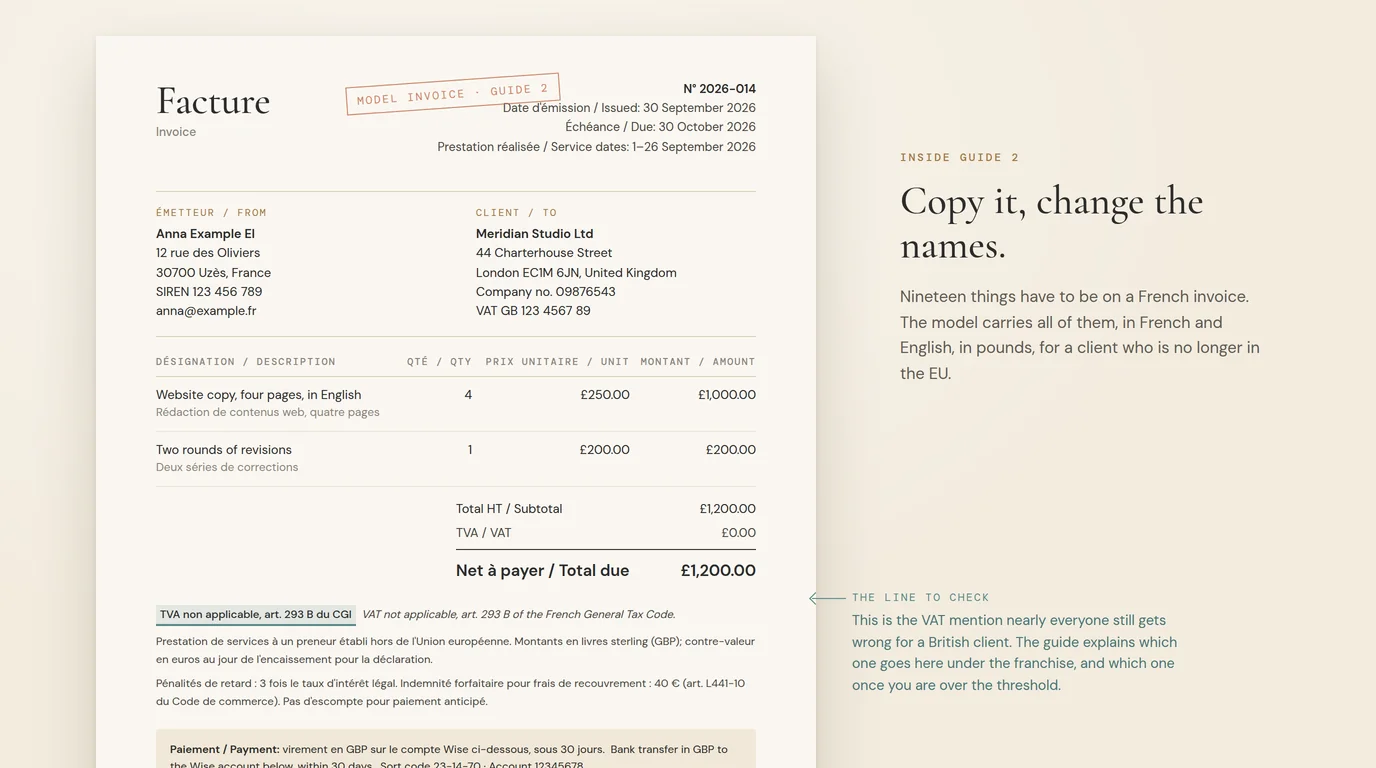
The full guide · €19
Invoicing a UK client from France
Thirteen pages, with a bilingual model invoice in sterling to copy. Every figure sourced and dated.
Get the guide →Or all three guides with the URSSAF tracker and the deadlines calendar: Micro Admin 2026/27, €49.
Other questions
- Can a Micro-Entrepreneur in France Invoice a UK Client in Pounds and in English?
- Do I Have to Put EI After My Name as a Micro-Entrepreneur?
- The €40 Recovery Fee and the Late-Payment Line Every French Invoice Needs
- Do I Have to Declare My Wise Account in France? Form 3916 for Micro-Entrepreneurs
- Does UK Client Income Count Towards the French VAT Franchise Threshold?
- Invoicing a UK Client from France: Which VAT Line, and Why Autoliquidation Is Now Wrong
Everything answered so far, in one place. If your question is not there, email it to [email protected]; the ones that come up more than once get a page.