Essays
Where the Black Keys Run Out
Every plan loses its push in the same two places. A piano keyboard shows you where.
4 Sep 2026 · 5 min read · By Sophie Kazandjian
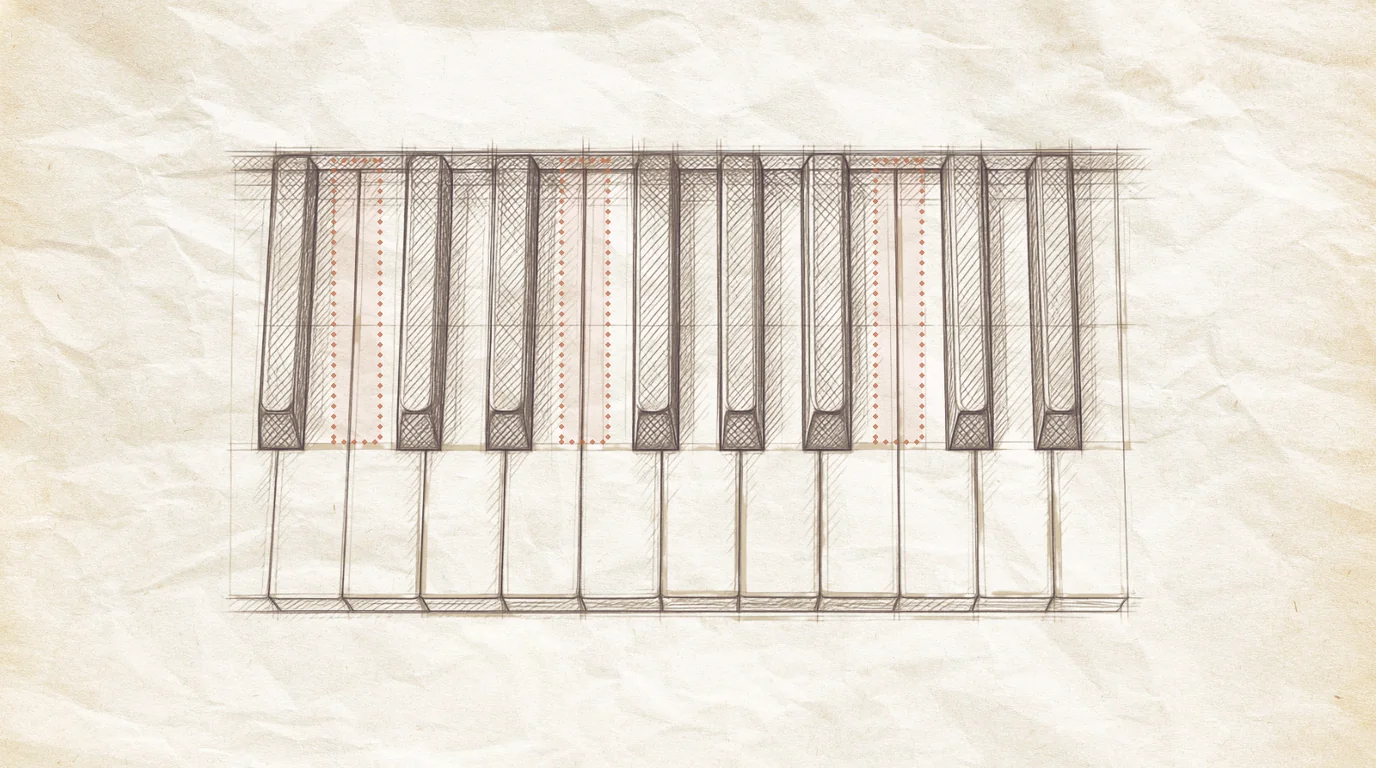
Look at a piano keyboard. Between most of the white notes there is a black one. In two places there is not: between E and F, and between B and C. Two gaps in every octave.
They are not a mistake. They mark the two places where the scale takes a small step instead of a big one. Musicians call the small step a semitone. The keyboard shows you where.
I have been playing across those two gaps since I was a child. I never thought about them outside music until this year, when I came across a teacher who thought they applied to everything.
A plan moves like a scale
George Gurdjieff was an Armenian-Greek teacher who died in 1949. He was also a composer. With Thomas de Hartmann he wrote several hundred short piano pieces in the 1920s, spare and hymn-like, music that Keith Jarrett later thought worth recording. A man who wrote like that had spent a long time at a keyboard, and it shows in the idea of his I cannot put down.
He called it the Law of Seven, sometimes the law of octaves: anything you set in motion, a project, a habit, a business, moves like a scale. It does not go up in a straight line. Most of the steps are big ones, and the energy of starting carries you up them. Two of the steps are small. At those two, the energy drops. The plan does not stop there. It bends. It carries on in a slightly different direction, and everyone still believes it is going where it started.
He put the two weak points exactly where the keyboard puts them. One third of the way up, at E going to F. And right at the end, at B going to C.
I know those two places from the inside, because every composer does. The first is where a piece runs out of its opening idea. You have your tune, you have done the obvious thing with it, and one morning you sit down and it has nowhere to go. Most of the unfinished pieces in my folder died there, a third of the way in. The second is stranger. It comes when the piece is nearly finished and will not close. There is always one more bar to fix. Some of my pieces sat one note from the end for years.
What music has that a plan does not
Now the part that made me sit up. In music, the last gap looks after itself.
The seventh note of a scale is called the leading note, because it leads. Play a B in the key of C and hold it, and you will feel your whole body wanting the C. The pull is built into the note. The smallest step in the scale carries the strongest wish to finish. That is why the ending of a piece of music feels inevitable rather than chosen.
A plan has no leading note. Nothing in a business effort pulls it home. When you are one step from finishing a launch, a book, or a website that has been nearly done for a year, there is no B under your hand aching for the C. There is the last five per cent, and a tired person, and the tiredness usually wins.
The first gap is harder still, because music does not solve that one either. E to F has no special pull. Composers get across it by preparing in advance: a second tune, sketched early, so that when the first one is spent there is somewhere to go. The ones who do not prepare a second tune write a lot of beginnings.
Writing in the missing notes
Gurdjieff's word for what carries a process across its small steps was a shock. He meant something from outside, arriving at the gap, that does not depend on how you feel when it arrives. I dislike the word, and I have kept it, because every gentler word I tried made it sound optional.
This is where my two lives meet. My work is digital operations for small businesses. For years I described it as setting up systems, which was true and told nobody anything. What I actually do, I now think, is write leading notes into plans that were composed without them.
A check-in that sends itself in week three of a programme, whether or not anyone remembers the programme is running, is a note placed at E. A review that sits in the calendar before the project it reviews exists is a note placed at B. Payroll that runs on the first working day of the month without a decision. An onboarding sequence built and tested before the first client has signed, so that when the launch reaches its last small step there is nothing left to finish.
None of these feels like anything on the day it fires. That is what a leading note feels like from inside the music. You do not notice the pull. You notice that you arrived.
Where the effort usually goes
Almost every small business I have worked with puts its energy at the start of the scale, on the big steps, where the push of starting does the work for free. The name, the brand, the plan, the choice of tools. All of it is done while everyone is fresh, and it is the part that needs the least help. By the time the effort reaches E, the founder is tired, and nobody's job was to have prepared F.
A business with nothing placed at its two small steps will bend at both of them, every time, and will not notice. It will call the newsletter the plan. It will call the ninety per cent website nearly done. It will stay, quietly and for years, one note from home.
The folder of beginnings
I still have my folder of unfinished pieces. I know now, for each one, which gap it died in. In most cases what was missing was small and could have been written on the first day: a second tune sketched before the first ran dry, or a performance booked so that an ending had to exist by a date.
I set up other people's plans for a living, and the first thing I do now on any new piece of work is find E and B and decide what will be waiting there. It is the least glamorous hour of the job and the only one I would not give up.
So, for whatever you are starting this month: where are your black keys missing, and what have you written there?
Listening
If you have not heard Gurdjieff's music, start with an hour of it arranged for violin and strings, which is how I first came to it. For the piano pieces as he and de Hartmann wrote them, Keith Jarrett's Sacred Hymns (ECM, 1980, also on Spotify) is the recording to own, and Alain Kremski's hour at the piano runs from the Struggle of the Magicians excerpts through Journey to Inaccessible Places to the Hymns from a Great Temple. Anja Lechner and Vassilis Tsabropoulos's Chants, Hymns and Dances puts the same music on cello and piano, and the Gurdjieff Ensemble plays it on the Armenian folk instruments it was drawn from. My own pieces, the ones that made it out of the folder, are at sophiesmusic.com.
If you would like help finding the two small steps in your own business, and building the notes that carry it across, that is the work I do. Get in touch.