Tools & Tutorials
E-invoicing in France for Micro-Entrepreneurs: The Questions Freelancers Keep Asking in 2026
Eight e-invoicing, VAT and URSSAF questions English-speaking micro-entrepreneurs in France ask most, answered plainly.
6 Sep 2026 · 6 min read · By Sophie Kazandjian
Every English-speaking micro-entrepreneur in France ends up in the same forum threads. Survive France, the Facebook groups, the comments under an article in The Local. The emails call it facturation électronique, most of us still say auto-entrepreneur rather than micro-entrepreneur, and the questions are always the same. The answers are always slightly different, because the person answering is also guessing. I have been one of those people since 2018. What follows is the set of questions I have been asked most this year about electronic invoicing, UK clients and URSSAF, with the answers I now give, and where the true answer is "nobody has decided yet", it says so. The long versions, with the model invoices and the sources, are in Micro Admin 2026/27, the guide I wrote so that I would stop answering from memory. The pages shown below are from it.
Is the e-invoicing email from FinancesPubliquesFr real?
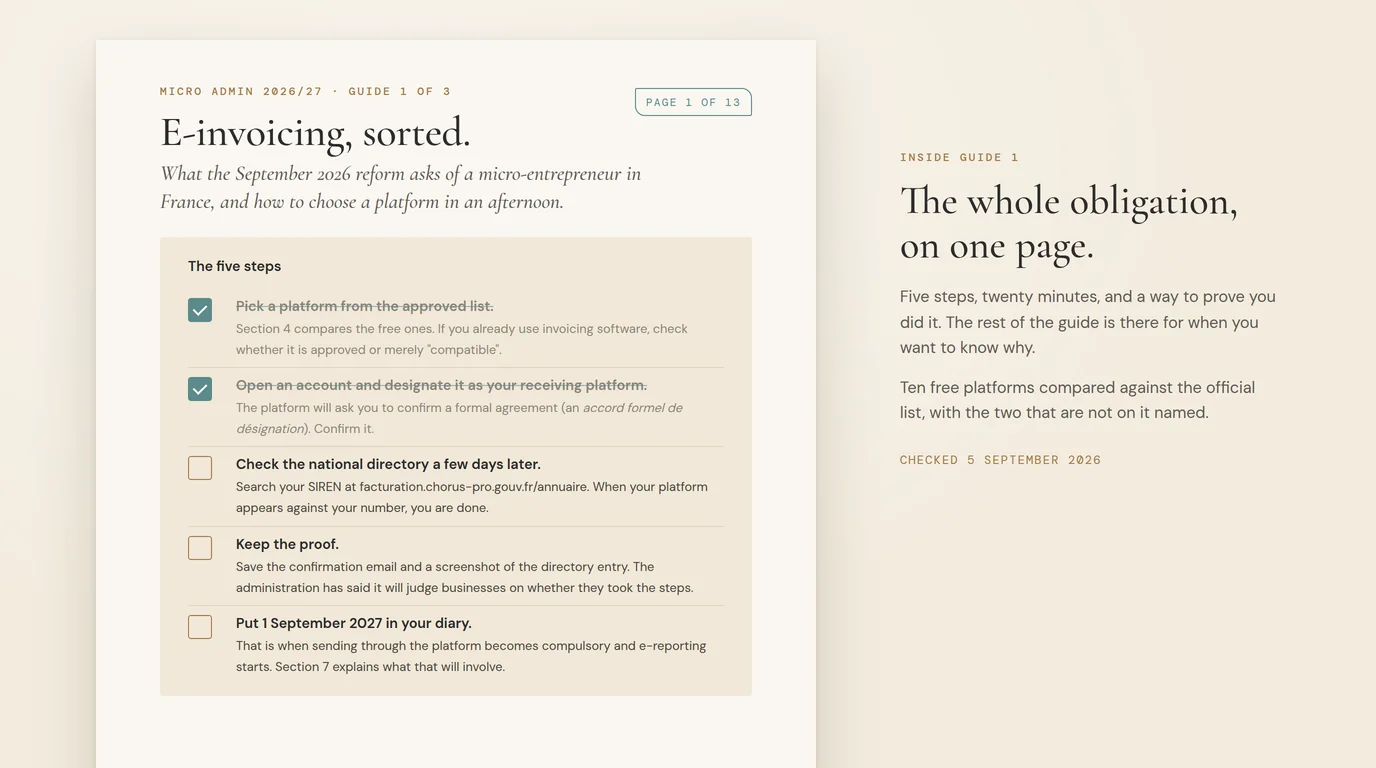
Yes, and it is not spam, although it reads like it. Since 1 September 2026 every business in France that is subject to VAT has to be able to receive electronic invoices, and the tax office wrote to roughly six million businesses in April and again in June to say so. "Being able to receive" means one thing: you choose an approved e-invoicing platform, a plateforme agréée, tell it in its settings that it is your receiving platform, and it registers your SIREN in the national directory. That is the whole obligation for now. The real email links to impots.gouv.fr and asks for nothing, no payment, no password, no bank details. Anything that asks you to pay a fee to "register your platform" is not from the tax administration.
One thing the email does not say: a PDF attached to an email is not an electronic invoice in the sense of this reform. An e-invoice is a structured file, usually Factur-X, that travels between approved platforms. You will never need to know the format, because the platform produces it, but it explains why "I already email PDFs" is not the same as being compliant from September 2027.
Does e-invoicing apply to a micro-entrepreneur under the VAT franchise?
It does, and this is the one that catches most people. The franchise, the "TVA non applicable, art. 293 B du CGI" line on your invoices, is a VAT regime, not an exit from the VAT system. You are registered for VAT and excused from charging it, which is a different thing. The tax office's own FAQ answers the question "franchisé en base, micro-entrepreneur, suis-je concerné ?" in four words: "Oui, vous êtes concerné." The obligation is about receiving invoices from French suppliers, so it lands on you even if every client you have is abroad and you have never charged a centime of VAT. Sending your own invoices electronically does not become compulsory for micro-entrepreneurs until 1 September 2027.
Which e-invoicing platform, and does it have to cost money?
No, it does not have to cost anything. There is no state-run free portal, that plan was dropped in October 2024 and the ministry's own page now lists only private approved platforms, but several approved platforms cover everything a micro-entrepreneur needs on a free plan. When I checked in September 2026, Indy, Tiime, Abby, Qonto Facturation, Shine, Pennylane and Dougs were all on the official list with a free tier, and three of them, Qonto, Shine and Pennylane, work in English.
Two things to watch. Some well-known tools are "compatible solutions" rather than approved platforms, which means they plug into somebody else's platform: Henrri and Freebe are the two most often recommended to freelancers, and neither is an approved platform under its own name. Check the official list on impots.gouv.fr before you sign up. And after a few days, search your SIREN in the national directory. If your platform shows against your number, you are done. Keep the confirmation email.
Is there a fine for missing the 1 September 2026 e-invoicing deadline?
The fine exists, set by the 2026 finance law: €500 after a formal notice and three months of silence, then €1,000 for every further three months, with a first offence forgiven if you put it right within thirty days. But the economy ministry has said there will be no penalties in 2026 for businesses making a serious effort, and the minister's office went further on 23 August, telling the press that in 2026 there would be no sanction for any business. At that point 58 per cent of VAT-registered businesses had designated a platform, so if you have not, you are in large company. So it is not an emergency. It is a job for a quiet afternoon, and I would do it this month rather than next, because the directory takes a few days to update and it is nicer to have the confirmation in hand before the next email arrives.
Can a micro-entrepreneur invoice a UK client in pounds, in English?
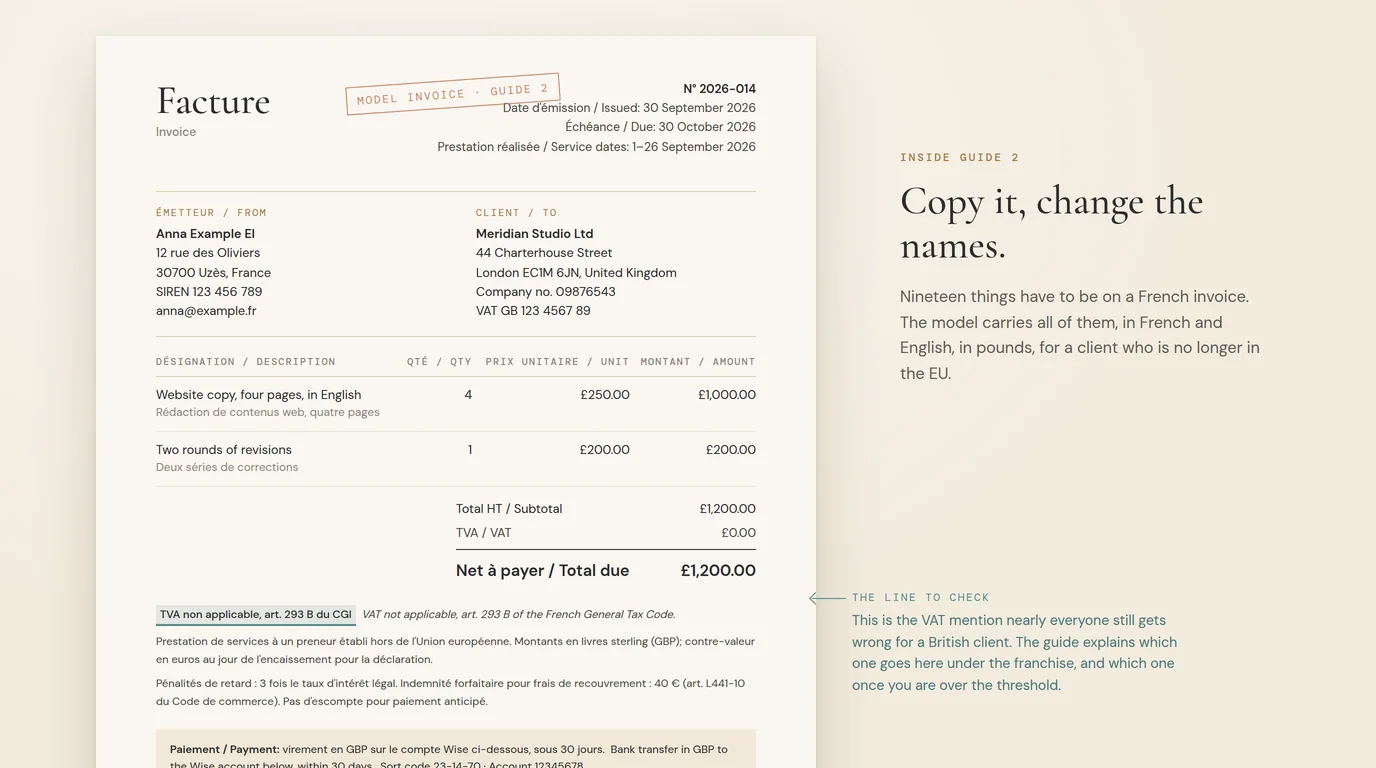
Yes to both. What the invoice has to carry is fixed by French law, nineteen mentions in all, and language and currency are not among the things that are fixed. Where people go wrong is the VAT line. Since the UK left the EU, "Autoliquidation", the reverse-charge wording that was right for a British client in 2019, is the wrong line, and the DES declaration you may have been told about no longer applies to UK clients either. The right wording depends on whether you are under the franchise or over the threshold. The second Micro Admin guide, Invoicing a UK client from France, has a full model invoice in both languages for each case.
What goes on the URSSAF declaration when a UK client pays in pounds?
The amount in euros on the date you were paid. Which exchange rate you use is one of the unsettled points: URSSAF publishes no rule for it, so the sensible course is to use the same method the income-tax rules use, note it in your register, and apply it consistently. Wise itself raises two further questions, because a Wise account has a Belgian IBAN, which means form 3916 every year, and there is a rule about micro-entrepreneurs keeping a dedicated business account that Wise Business may or may not satisfy. I use Wise. I also declare the account. Both of those are in the UK guide with the working shown.
Do UK sales count towards the French VAT franchise threshold?
This is the question I would most like a clean answer to and cannot give one. The July 2026 wording on the BOFiP suggests services to a business outside the EU do not count towards the franchise threshold; the 2023 wording said they did. If you are anywhere near the line, ask your Service des impôts des entreprises in writing and keep the reply. Anyone who tells you the answer with confidence, including a forum, is guessing, and this is the one place where a guess could cost you a VAT registration.
Will the e-invoicing rules change again in 2027?
Yes, in two places you can already see. The rates and thresholds move every January with the finance law, and e-invoicing moves again on 1 September 2027, when sending through the platform becomes compulsory for micro-entrepreneurs invoicing French businesses. The part most English-language coverage has missed is e-reporting: from that date the data from your foreign invoices, UK clients included, has to be transmitted to the tax office every two months through your platform. Your UK invoices stay as they are, PDF, in pounds, in English, but each one needs to exist in the platform so it can be reported. That is why I would start creating them there now. By next September the reporting then takes care of itself.
The guide
I wrote Micro Admin 2026/27 because I was tired of looking these things up. Here is what is in it. Three guides as PDFs: E-invoicing, sorted (fourteen pages, the five steps, ten free platforms compared against the official list), Invoicing a UK client from France (thirteen pages, the nineteen mentions, the VAT line, Wise and the declaration) and Clients in the EU, and everywhere else (twelve pages, business or private, inside the EU or outside it, and the paperwork for each). Model invoices in French and English, ready to copy, for a UK client, an EU business, an EU private individual and a client anywhere else. The declaration tracker, the spreadsheet I use for my own URSSAF declaration, which tells you what to declare, when, and how close you are to the thresholds. A deadlines calendar to the end of 2027, as a two-page PDF for the wall and as files for your phone that remind you a week before and the day before. Each figure has its source and the date I checked it. When the January rates come out, buyers get the update by email. It is €69, and for the first thirty copies the code FIRSTTHIRTY takes €20 off, so €49.
The guide
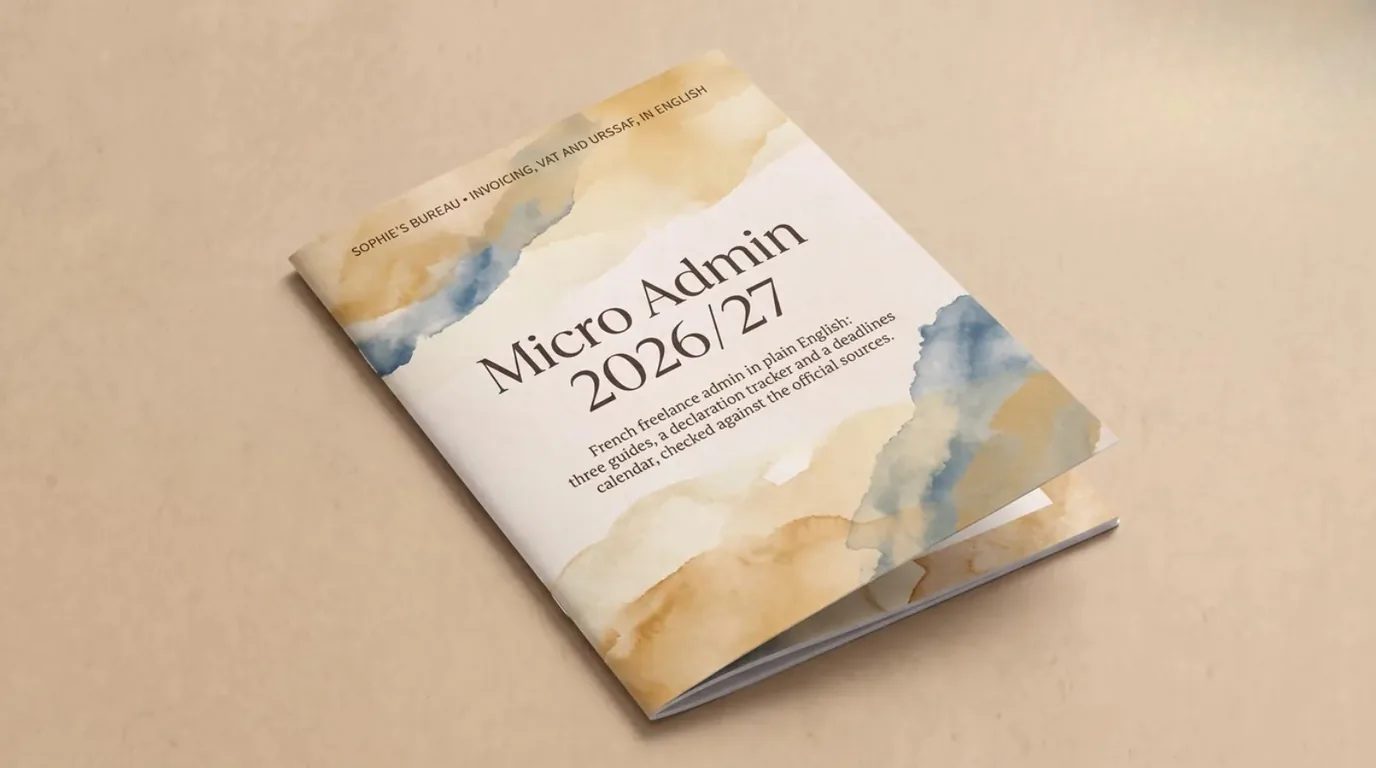
Micro Admin 2026/27
Three guides, four model invoices in French and English, the URSSAF declaration tracker and a deadlines calendar to the end of 2027. For micro-entrepreneurs in France who work in English. VAT included, January update by email.
Launch offer: the first thirty copies are €49 instead of €69. Use the code FIRSTTHIRTY at checkout.
If your question is not on this list, leave it in the comments below. The ones that come up more than once go into the January issue.