Tools & Tutorials
Three Binaural Beats Apps Built on One Sound Engine
Find Your Frequency, Deep Hours and Skin Resonance share the same audio engine and almost nothing else. What each one is for, why they look so different, and what the research supports.
9 Oct 2026 · 6 min read · By Sophie Kazandjian
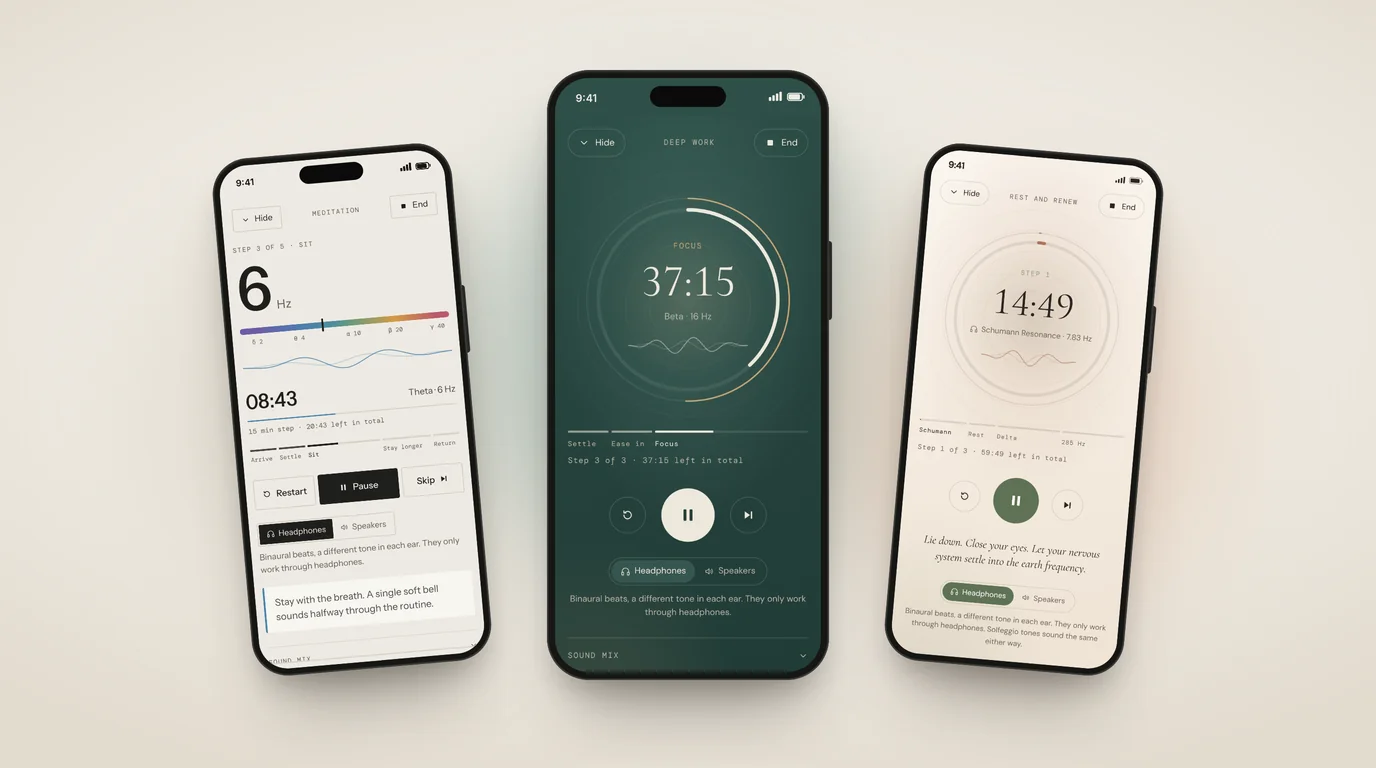
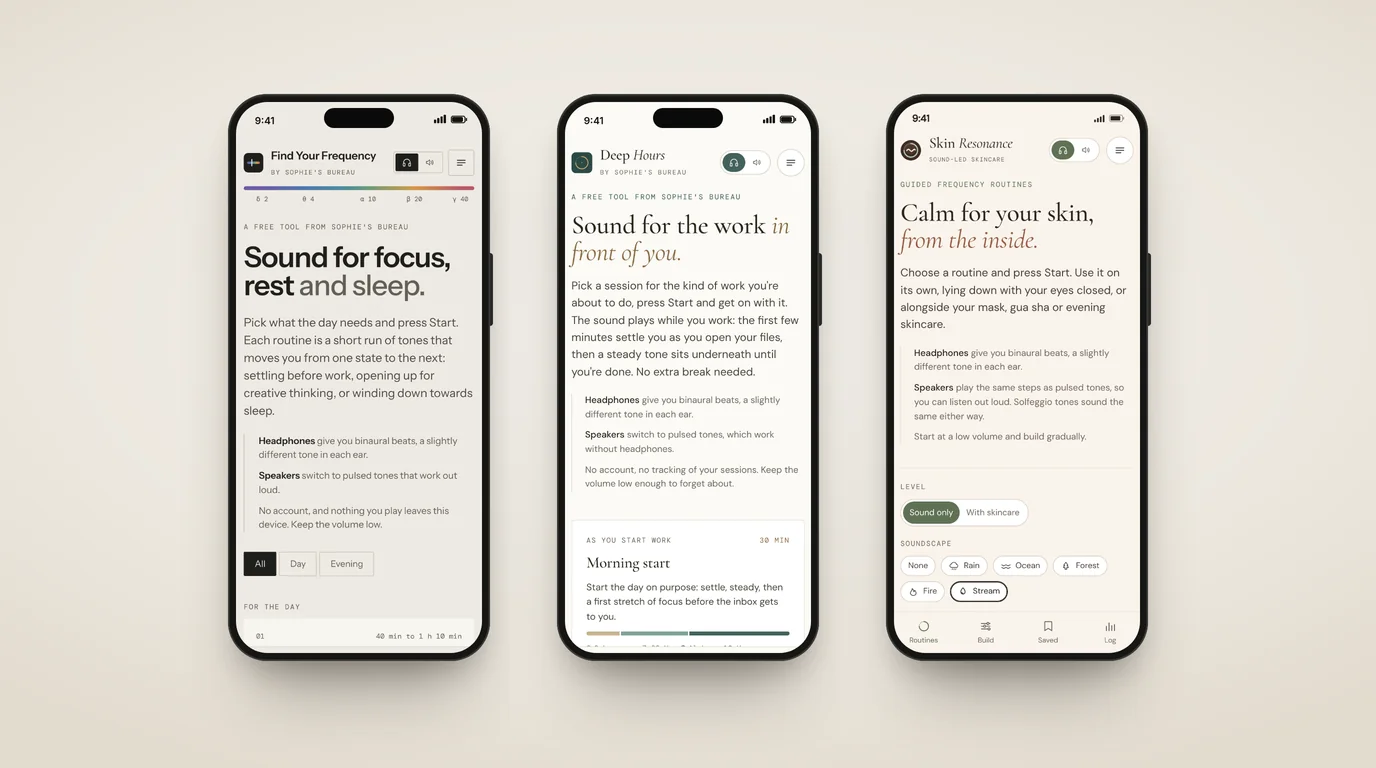
I have three sound apps now. Find Your Frequency came first, a free tool I built so I could stop looking up frequency values every morning. Skin Resonance grew out of it in the spring, a paid app for skin that reacts to stress and short sleep. Deep Hours arrived this month, for the working day. All three run the same audio engine, and on the screen they share almost nothing.
The engine underneath
None of the three plays a recording. Every tone is generated live in the browser by the Web Audio API, the sound system built into Chrome, Safari and Firefox. With headphones on, each ear gets its own sine wave a few hertz apart, 150 Hz on the left and 160 Hz on the right, and the brain hears the 10 Hz difference as a slow beat that exists only inside your head. Under it sits a bed of brown noise, made by a random-walk formula and filtered low so it reads as warmth.
Speakers can't do that, because both ears hear both tones. Switch to Speakers and the engine plays one tone whose loudness rises and falls at the beat rate instead: a pulsed, or isochronic, tone.
Getting the speaker version right took longer than anything else in the code. My first version pulsed hard over a near-silent bed. Even with a shallower pulse, a beta session through a laptop still sounded buzzy and urgent, and the cause turned out to be pitch. The beta tone sat at 220 Hz, which small speakers barely reproduce, so you turn the volume up and the speaker strains. In the two free apps the tone now sits between 264 and 360 Hz, about 8 dB above a warmer bed, with the pulse cut to roughly 6% of the volume at 16 Hz. The rhythm is still there. You stop noticing it.
Find Your Frequency
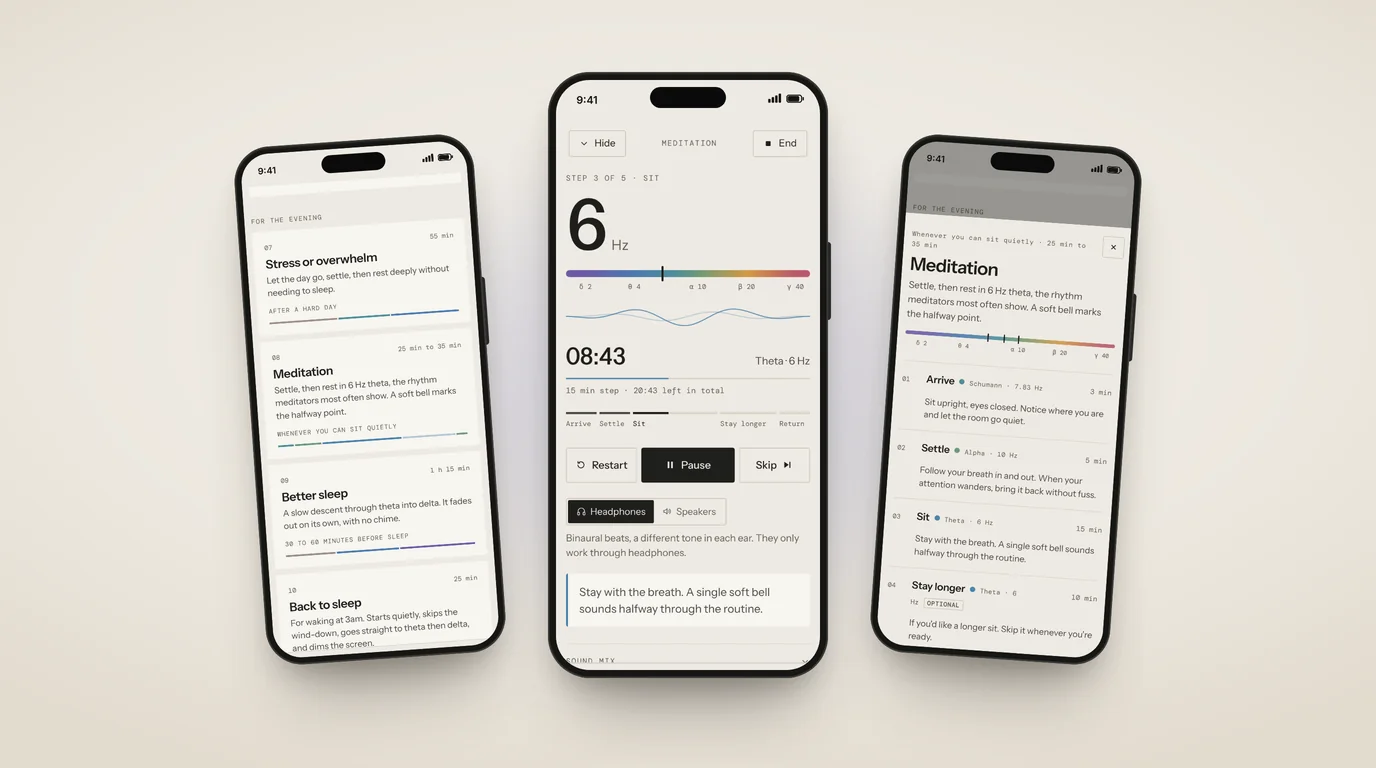
The general one, for the day and the evening. Its twelve routines run from Focused work day to Back to sleep, each a short sequence of steps that moves you from one state to the next. Three are new this week. Quick reset is seven minutes between tasks, alpha and then a lift to 14 Hz. Meditation rests in 6 Hz theta with one soft bell at the halfway point. Back to sleep, for waking at 3am, starts at half your usual volume, skips the wind-down, goes straight to theta and delta, and after ten seconds dims the screen almost to black so the phone's light doesn't wake you further.
It was redesigned in October around warm stone, graphite type and a single strip of colour: a spectrum from delta to gamma on a log scale. The player shows the frequency you are hearing in large figures, with a marker on that strip. A builder chains up to eight steps from eleven brainwave beats and the nine Solfeggio tones, and a log keeps your streak. Free, with no account.
Open Find Your Frequency →Free · no account
Deep Hours
Find Your Frequency rebuilt for the working day. Most people I work with have no room for a forty-five-minute listening ritual before they start, so each of its twelve sessions plays underneath the work from the moment you sit down. A few settling minutes run while you open your files, then a steady setting holds for the main stretch: 16 Hz beta for Deep work, 25 Hz for Long analysis, alpha for Writing and thinking. The ready-made sessions carry no Solfeggio tones and no healing claims, and the Evidence tab sets each setting beside the study it came from.
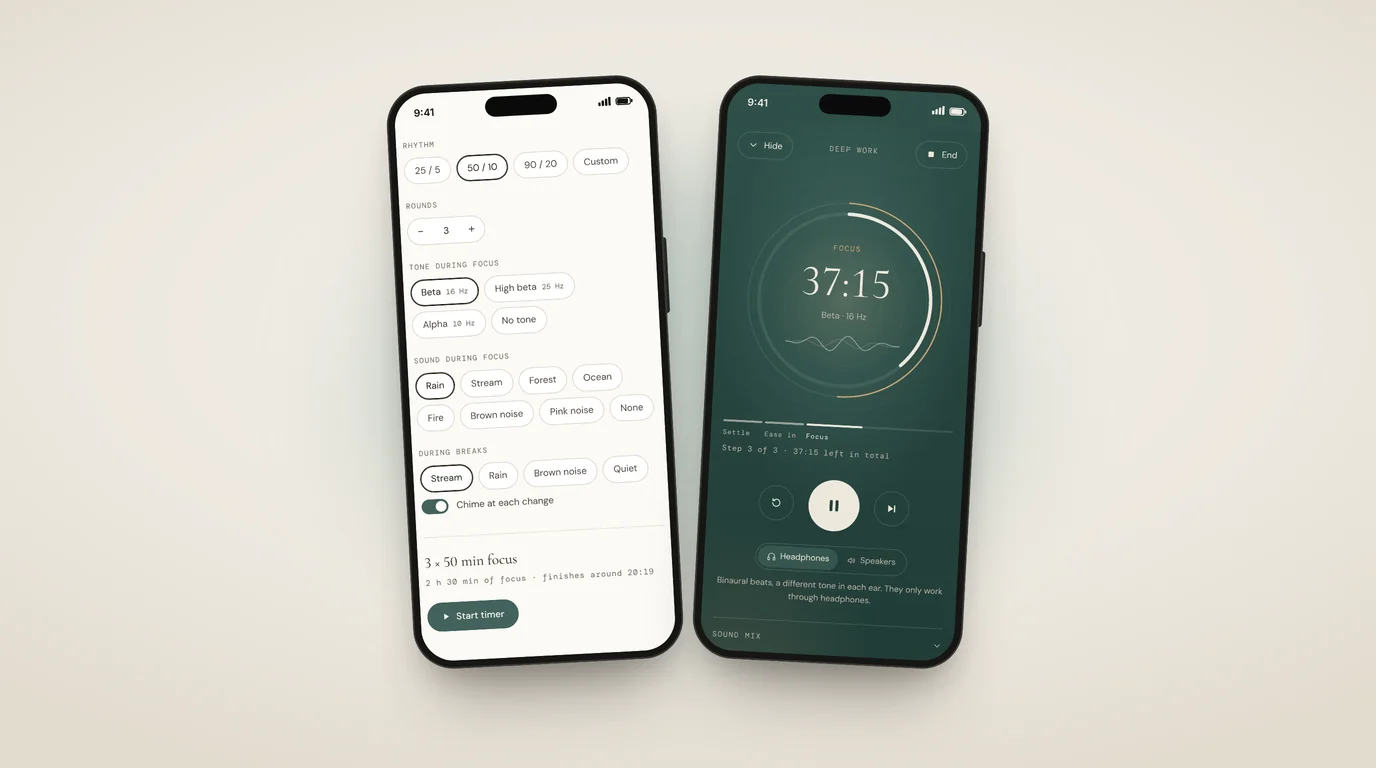
There is a focus timer that works in rounds, and from this week its sound comes in three parts: a tone for the focus rounds, rain or stream or noise under it, and something different for the breaks, so you hear a break start without looking. Office mode plays noise and recorded sound with no tones at all, for shared rooms. Its player is dark teal, with a ring counting down the step; when I rebuilt Find Your Frequency I wanted the two to look nothing alike.
Open Deep Hours →Free · no account
Skin Resonance
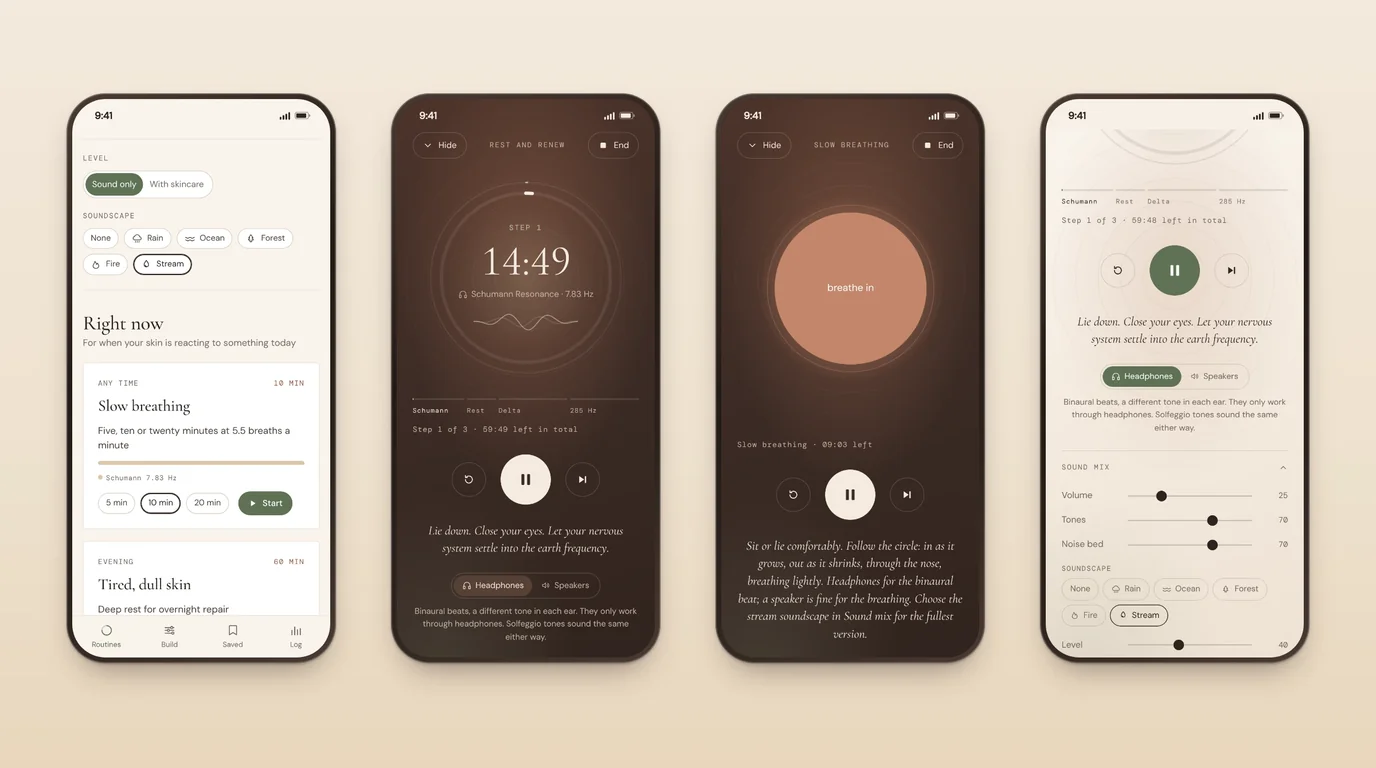
The only one that costs anything: €12 once, about £10, with no subscription and no account. It builds fourteen routines around skin concerns, from stress breakouts and period week to perimenopause, post-treatment recovery and an everyday reset. Each has two levels. Sound only is the routine by itself. With skincare builds it around the tools you own and tells you when to use each one, so the serum, the gua sha or the red light mask lands in the right step.
The mechanism is indirect, and the app says so on every page. Binaural beats and steady sound lower self-rated stress in small trials; a calmer nervous system runs lower cortisol; skin repairs its barrier faster in that state. No study has measured a skin outcome from a sound practice. October added a slow-breathing routine at 5.5 breaths a minute, the pace heart-rate-variability research points to, with a circle that grows on the in-breath and shrinks on the out.
See Skin Resonance →€12 once · free 10-minute taster
Why three apps and not one
Each audience decides what goes on its screen. Someone opening Deep Hours at nine in the morning wants a session and a Start button, not a menu of sleep routines and Solfeggio tones. A person choosing a routine for perimenopausal skin wants the skincare steps in order, which would be clutter to anyone else. One app for all of them would have opened with a settings page asking who you are.
Sharing the engine means a fix lands wherever it is needed. The speaker change went into both free apps on the same afternoon, from the same code. Claude wrote that code, and every screen. The frequencies, carriers and levels, and the decision about what each app is for, were mine; I wrote about that split in How a Free Tool Became a Paid Product.
| App | For | Price | Where |
|---|---|---|---|
| Find Your Frequency | Routines for the day, the evening and sleep | Free | frequencies.sophiesbureau.com |
| Deep Hours | Focus sessions, a timer and office mode | Free | sophiesbureau.com/resources/deep-hours |
| Skin Resonance | Routines for stress, sleep and skin | €12 once | skinresonance.com |
What the research supports
The strongest single source is a 2019 meta-analysis of 22 studies, which found a medium, consistent effect of binaural beats on anxiety, on attention and memory, and on how much pain people reported. Listening before a task as well as during it did better than listening only during it, which is why every routine in all three apps opens with a settling stretch. A 2015 review of 56 EEG studies found mindfulness most often linked with more alpha and theta activity than resting with the eyes closed, and Meditation sits in theta for that reason. How the beats have their effect is still open: a 2023 review of 14 EEG studies found the brain's measured response varied too much between studies to say.
Pulsed tones have far less behind them. The speaker setting is a comfortable alternative, not an equivalent, and headphones stay the better choice when you have a pair.
Common questions
- Do I need headphones?
- For binaural beats, yes, because each ear needs its own tone. Every app has a Speakers switch that plays pulsed tones out loud instead. The Solfeggio tones and the recorded soundscapes sound the same either way.
- Which ones are free?
- Find Your Frequency and Deep Hours are free, with no account and no trial. Skin Resonance is €12 once, with every future update included.
- Do they work offline?
- Yes. Each one installs to your phone's home screen or your computer like an app, and after the first visit it runs without a connection.
- Where does my listening history go?
- Nowhere. None of the three has an account, and each keeps its log in your own browser.